
Greenroom Robotics Wants to Put its Brains on Your Boat


Brett Davis is a lifelong journalist and writer with extensive experience writing about defense issues and technology. He studied journalism and photography at the University of North Alabama in his hometown of Florence and then earned a master’s degree in journalism from the University of Missouri. He worked for a dozen years as Washington Correspondent for the Huntsville Times newspaper, then became editor of Aerospace Daily & Defense Report, published at the time by McGraw-Hill. He served as content manager for Backfence.com, a pioneering local journalism website, was editor of Unmanned Systems magazine at the Association for Uncrewed Vehicle Systems International and editor in chief of Inside Unmanned Systems magazine for Autonomous Media. He previously served as Deputy Editor of Seapower magazine. He’s also a fiction writer: His latest, The Moon Above, is the story of a Tuskegee Airman published by Scarsdale Publishing.
By Brett Davis, Editior-in-Chief
New small- and medium-sized uncrewed surface vessels are emerging from the waves everywhere at Sea-Air-Space, and one small Australian company is marketing its software to operate them.
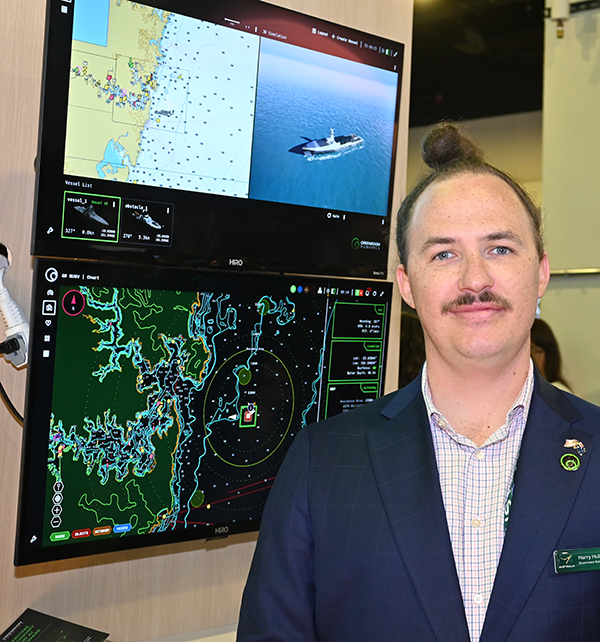
“We are a pure software company,” said Harry Hubbert, chief operating officer for Greenroom Robotics (Booth 1537 in the Australian pavilion), formed in 2017 when its founders met at the Australian Maritime College in Launceston, Tasmania, and bonded over a passion for ocean adventures and maritime robotics (the company’s name is a surfing term referring to the inside of a barrel produced by a wave).
The company has four products: GAMA, a navigation and control system; Lookout +, an AI-powered optical radar that’s fully passive and can be used in contested environments, according to James Griffin, sales engineer at Greenroom; MIS-SIM, a mission simulator for training and planning; and MAROPS, a digitized mission management system. The products can work alone or together.
The company’s software has been used on a retrofitted Aermidale-class patrol boat with Austal in Australia; a high-speed, agile uncrewed surface vessel from Subsea Craft in Australia, the United States and the United Kingdom; a EGS Survey USV in Australia and about 30 other vessels around the world, Hubbert said.
“You can come to us with a boat that’s 25 or 30 years old, and we can make it into a fully autonomous boat,” Griffin said, or companies can bake the software into new USVs being developed.
There are many USVs on display at the show this year and Greenroom Robotics has been talking to them, and the Navy push with the new Medium USV program and others is helping, Hubbert said.
“The United States is a really big focus for us, given the scale of the operation over here but also the clear need,” Hubbert said. “The U.S. government’s been great at actually defining that they want this and this is what they want to do, and we happen to meet a lot of their requirements, so it’s been a good opportunity for us here.”
The AUKUS agreement between the U.S., U.K. and Australia has eased the regulatory burden, “cracked the door open and allowed us to get moving a little bit faster,” Hubbert said, but the self-funded company is also setting up a shop in the U.S. and hiring Americans to help navigate the defense market.