
Leidos, HavocAI Join Forces to Advance UAV Interoperability Across Domains


By Erika Fitzpatrick, Seapower Correspondent
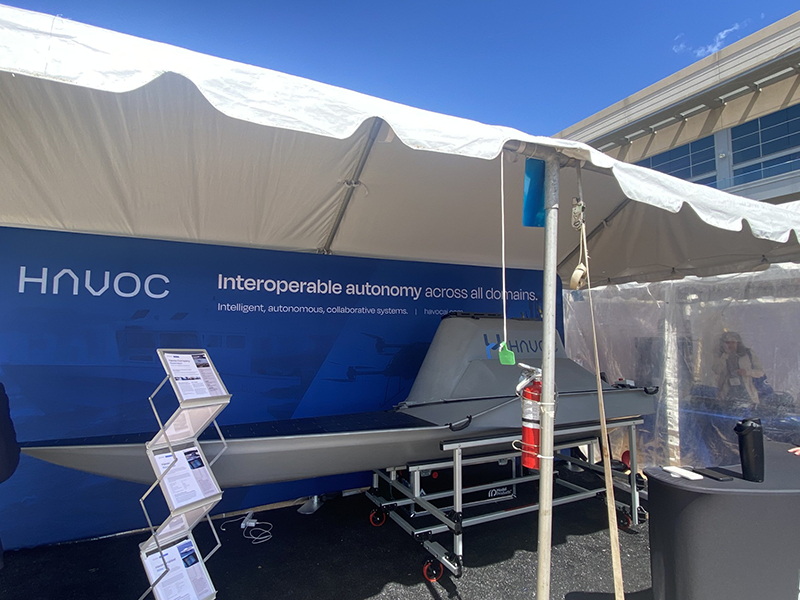
Leidos (Booth 1125)and HavocAI (D 17) have teamed to test a new fleet of autonomous uncrewed surface vehicles that offer unique capabilities in multidomain environments, company leaders said April 20 at Sea-Air-Space 2026.
“Warfare is changing rapidly,” said Cindy Gruensfelder, president of Leidos Defense, a global defense contractor with 9,000 employees. “It’s really requiring systems to connect together even more than normal and collaborate across all domains.”
She noted that the Navy can best deploy USVs that are integrated within a larger ecosystem that enables real-time collaboration with greater reach. She said the new partnership pairs Leidos’s proven autonomy at scale with HavocAI’s “all-domain collaborative autonomy” to deliver the Navy autonomy at speed and scale.
The defense sector has dived headlong into the USV space in the hopes of securing some of the billions of dollars the military is expected to allocate for small, medium, and large USVs in the coming years.
The Navy’s 2025 shipbuilding plan calls for spending $40 billion per year to create a 381-ship battle force by 2054, about 85 more ships than it has now, and an additional 130 unmanned surface and undersea vessels. This combined fleet would result in a “more lethal and distributed naval force,” the Navy has said.
To expand access to innovation, more traditional defense firms like Leidos are pairing with upstart players such as HavocAI, a Providence, Rhode Island-based aerospace and defense company founded in 2024.
HavocAI specializes in collaborative autonomy, CEO and cofounder Paul Lwins said at the event.
“What that means is making thousands of autonomous systems work together and work with the humans to do very sophisticated things,” Lwin said.
So far, Lwin said, HavocAI’s 100 or so USVs have shown they can work together. The company also acquired an aerial drone company to integrate those types of systems with autonomous surface vessels.
This fall, the Leidos-HavocAI team will conduct an on-the-water operational evaluation of about 10 UAVs at disparate locations. The test aim to prove the hybrid vessels are interoperable at sea, undersea and in the air, across far-flung locations.