
LMADIS Prepares for Future Fight
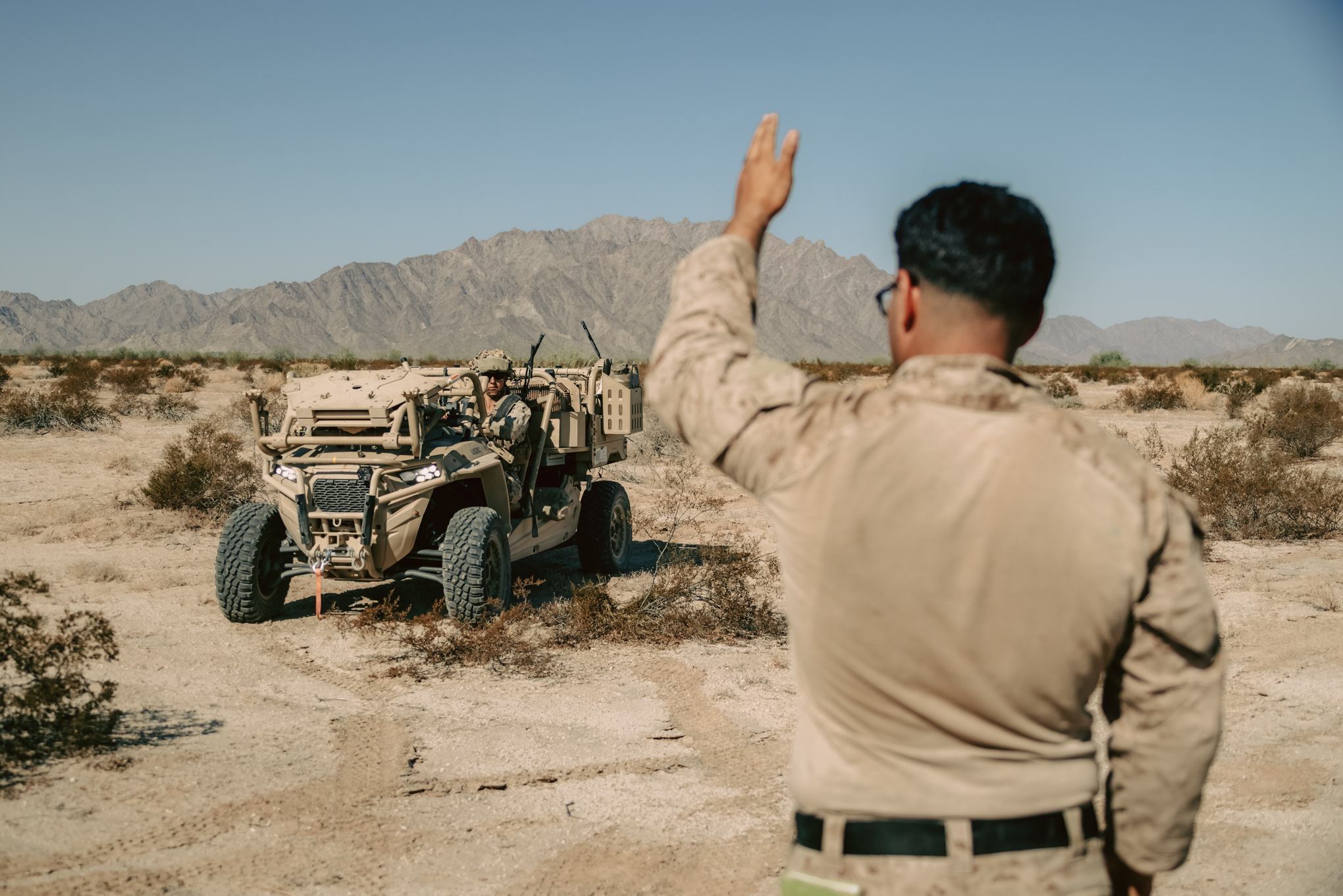


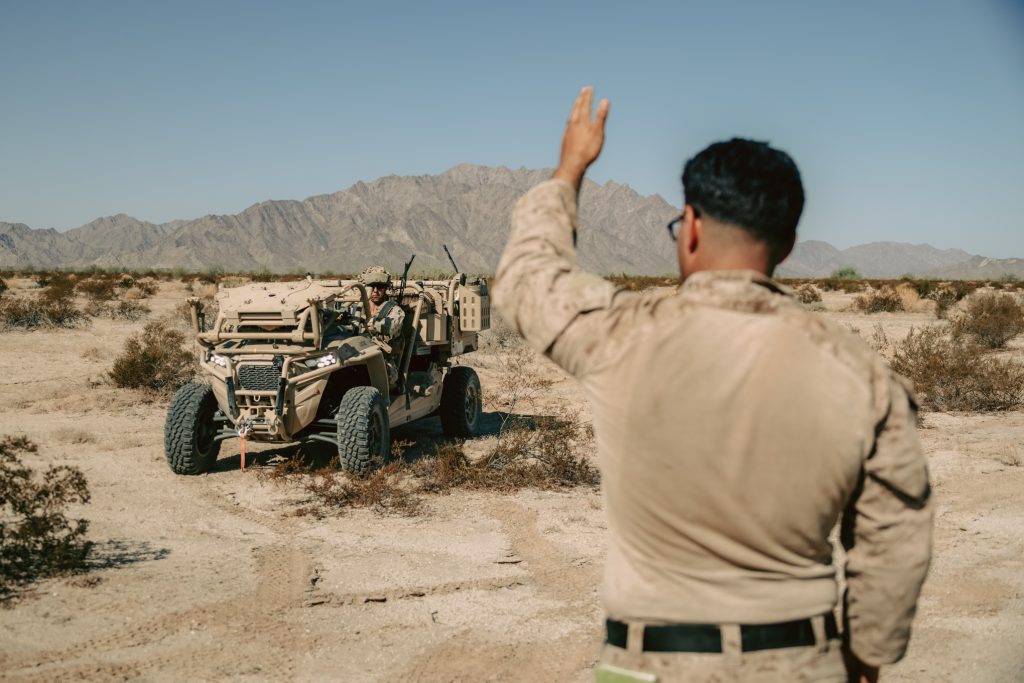
MARINE CORPS AIR STATION YUMA, Ariz. — The U.S. Marine Corps has taken significant strides in enhancing its air defense capabilities since the introduction of the Light Marine Air-Defense Integrated System in October 2022. This ground-based system is designed to deter and neutralize unmanned aircraft systems, addressing the evolving threats faced in modern warfare.
The LMADIS consists of two all-terrain Polaris MRZR vehicles — one serving as a command unit, while the other is equipped with advanced sensors and signal-jamming technology.
For the first time, LMADIS has been integrated into the Marine Corps’ premier advanced aviation school at Marine Aviation Weapons and Tactics Squadron One (MAWTS-1) — Weapons and Tactics Instructor course, WTI 1-25 — as an employable capability throughout each evolution, showcasing its operational viability and reinforcing the Marine Corps’ commitment to enhancing air defense.
“The significance of being out here for the first time is us being able to employ LMADIS in a controlled exercise scenario, safely testing limits and seeing what all the systems can provide to the Marine Air-Ground Task Force at large,” said 1st Lieutenant Gordon Armstrong, LMADIS Platoon Commander, 3rd Low Altitude Air Defense Battalion.
As part of ongoing Force Design initiatives, the Marine Corps is focusing on distributed maritime operations and reintroducing short to medium-range air and missile defense systems to address the need for an organic air defense capability.
LMADIS systems and teams are typically deployed worldwide, limiting exposure to fleet Marine forces in garrison. The LMADIS team’s integration with WTI 1-25 provides a valuable opportunity for Marines to train hands-on with other units and capabilities, integrating their tactics into a broader operational framework.
“Having LMADIS teams here at WTI allows us to integrate with the other agencies and into the broader systems that we test here; it allows us to incorporate everyone else’s tactics into our tactics,” Armstrong said. “As we grow, we will be working with other aviation units to mobilize and integrate with the other elements by the final exercise, simulating a larger operational scenario.”
The WTI 1-25 curriculum offers multiple training evolutions with different scenarios for the LMADIS teams to test when and where the system is most effective. As the course advances, similarly the evolutions and scenarios increase in complexity.
“With the WTI structure, we are able to start small and work to gradually build the scenarios,” said Major Dusty Blanchard, Ground-Based Air Defense Division Head, MAWTS-1.
Commandant of the Marine Corps, General Eric M. Smith, emphasizes a realistic, creative approach to training in his recent planning guidance.
“We must fully integrate constructive and virtual training into our exercises to complement live force actions so that we can train with the full complement of our new capabilities,” Smith said.
As the course progresses, the training evolutions begin to incorporate live UAS operations. This live-fire component allows LMADIS operators to practice identifying, tracking, and simulate neutralizing UAS threats in real time, enhancing their tactical proficiency and response capabilities.
A testament to its mobility and versatility, the LMADIS was rapidly transported on various Marine Corps aircraft platforms throughout the training.
“For the first time, we will be implementing the LMADIS fully capable and fully transportable via MV-22B Ospreys and CH-53E Super Stallions, demonstrating its versatility and readiness for deployment in various environments,” said Sergeant Angel Lopez, LMADIS team leader with 3rd LAAD Battalion. “This allows us to work with the flying divisions within MAWTS-1 to get us to our target location.”
The successful integration of the LMADIS in WTI 1-25 represents a pivotal advancement in the Marine Corps’ air defense strategy, ensuring that LAAD Marines are equipped with the tools, knowledge, and experience necessary to operate effectively on an increasingly complex battlefield.