
Naval Aviation at Highest Readiness in Years, ‘Air Boss’ Said


Richard R. Burgess, is senior editor for Seapower magazine. He is a retired naval flight officer and author of several books on naval aviation.
By Richard R. Burgess, Senior Editor
ARLINGTON, Virginia — U.S. naval aviation is at its highest readiness in years, a senior naval aviation admiral said to an audience in Washington and online.
Speaking Aug. 26 in an event of the U.S. Naval Institute and the Center for Strategic and International Studies sponsored by HII, Vice Admiral Daniel L. Cheever, commander Naval Air Forces and commander, Naval Air Force, U.S. Pacific Fleet — the Navy’s Air Boss’ — said the Naval Air Forces are “sustaining the readiness increases that we enjoyed” and “we’re at the “highest state of readiness we’ve had in at least 10 to 15 years back. And so, both carriers and the air wings with the carriers and our expeditionary forces are all at that heightened readiness.”
Cheever said that small pockets of challenges to readiness remained, particularly with the management of the supply chain and sustainment,
“We have a good playbook,” he said. “When there is a challenge, we get after it, and we have a perform-to-plan that re-energizes and gets us back to where we should be for readiness, and that’s across the board. And it’s pretty exciting to be part of that. It’s a lot of hard work but it is totally worth it. The return on investment from all of that parts supply is in the readiness of the force.”
Cheever praised the F-35 Lightning II strike fighter as “a game changer, a difference maker in the fleet,” while noting that there are some supply-chain challenges that are being addressed.
He said that a mixture of 4th-, 5th-, and 6th-generation mix of carrier-based strike fighters with manned-unmanned teaming is the “right blend.”
The 6th-generation strike fighter is being designed to replace the F/A-18E/F Super Hornet strike fighter and the EA-18G Growler electronic attack aircraft.
Cheever offered no details of the concept for the 6th-generation strike fighter but said that “I see a maritime version of the aircraft that starts at the carrier, is made for the carrier, and is a complete carrier version … I’m looking forward to the down-select… because that 6th generation means air superiority in that timeframe in the future, which means sea control.”
He affirmed that aircraft carriers will be central to air superiority in the future for the Navy and America as a maritime nation.
He noted that the MQ-25 Stingray unmanned refueling aircraft will fly this year and be integrated with the aircraft carrier next year.
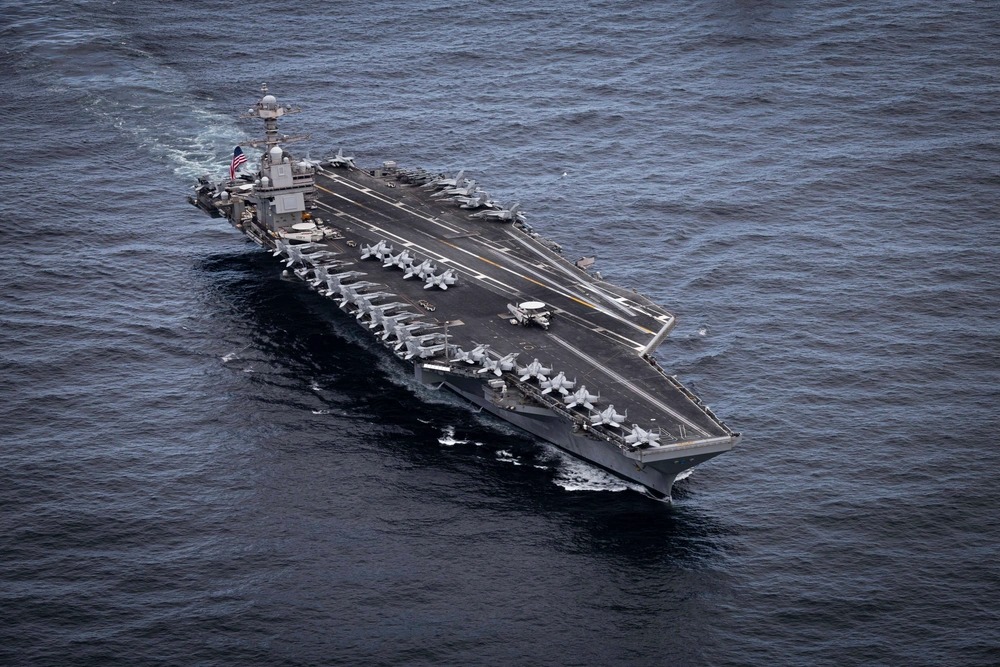
The air boss praised the design of the USS Gerald R. Ford, lead ship of the Navy’s newest class of aircraft carriers. The position of the island superstructure is farther aft than on the Nimitz class produces less of an air burble for approaching aircraft. The increase of aircraft parking space forward of the island eases aircraft handling and enables an aircraft to park directly over a weapons elevator for weapons download.
He also noted that, unlike the Nimitz class carriers, the Gerald R. Ford is completely air conditioned.