
Parsons Offers Counter-UAS Technology to Protect Marine Corps Installations


Richard R. Burgess, is senior editor for Seapower magazine. He is a retired naval flight officer and author of several books on naval aviation.
By Richard R. Burgess, Senior Editor
ARLINGTON, Va. — The U.S. Marine Corps is seeking counter-unmanned aerial systems technology to protect its installations. One of the companies bidding to be the provider is Parsons, in partnership with Rafael Systems Global Sustainment LLC (RSGS).
Counter-Unmanned Aerial Systems (CUAS) is a sector of defense technology that has been of increasing focus over the last decade and has become even more to with the extensive use of UAS in the Ukraine War, the Israel-Hamas War, and the Houthi drone attacks against naval and commercial shipping in the Red Sea.
The need to provide force protection extends not only to deployed forces but to their installations.
The Marine Corps solicited proposals for “installation counter-small UAS,” said Christopher Hamilton, vice president for innovative technology solutions at Parsons, in an interview with Seapower. “They’re looking to protect Marine Corps facilities and infrastructure around the world from the small UAS threat, primarily Group 1and Group 2 UAS, but some Group 3 potentially as well. That’s the lower half of the UAS spectrum, but those drones, as we’ve seen, can do quite a bit of damage if configured in the right way and with explosives, or just wreak havoc in terms of security responses to drones, as we’ve seen with sporting events over the past year or so.”
Parsons, in its proposal, is the prime solutions provider, delivering overall program management, sustainment, and systems integration, while RSGS is providing the Rafael Drone Dome System, a Parsons spokesman said.
The Marine Corps requirement is focused on its permanent installations in the United States and overseas, Hamilton said, noting that Parsons has “years and years of experience of developing, integrating, and deploying critical infrastructure protection systems, and over the past few years, CUAS has become really the most critical of those infrastructure protection components.
He said the Marine Corps requirement for infrastructure protection played to the strengths of Parsons, which has been “deploying CUAS systems for other clients around the world to do very similar functions.”
Parsons’ analysis of the Marine Corps requirement came down to providing two capabilities: the most effective system and the most available system — 100% of the time.
The Drone Dome system would be tailored specifically for the Marine Corps. Hamilton said it was the most battle-proven system and has been deployed in several different theaters with great success in defeating threats.
In addition, Hamilton said that Parsons “has the knowledge and experience to manage a global logistics enterprise, where you’re looking to maintain near 100% availability of systems. We do that today.”
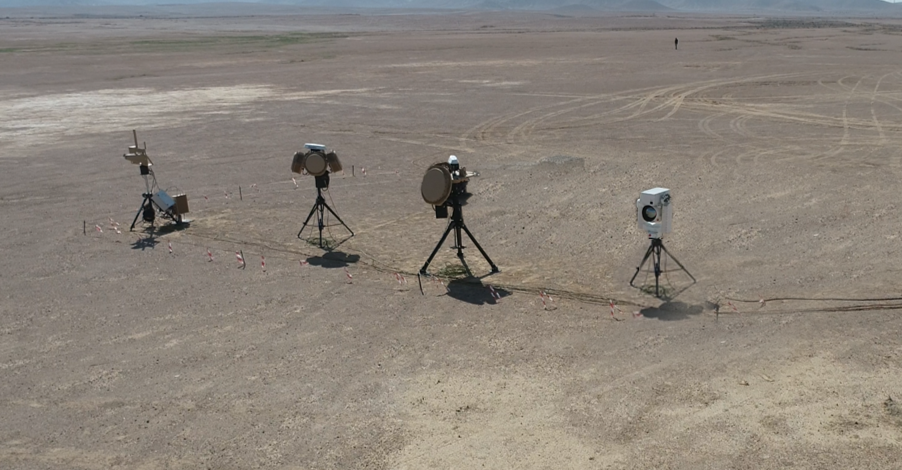
The Drone Dome system includes a command-and-control system, RF sensors, radars, and kinetic and non-kinetic effectors that are options. The Marine Corps requires a modular open systems approach to allow the system to adapt to evolving threats. It will make maximum use of artificial intelligence.
“It’s clear that the Marine Corps wants a system that evolves over time,” Hamilton said.
Parsons, based in Chantilly, Virginia, has a center of excellence for CUAS at Summit Point, West Virginia, where it assesses CUAS threats.
Parsons delivered its proposal to the Marine Corps in April. A single contract award in the competition is expected this summer. The program is to have a duration of at least 10 years.