
President Carter’s Funeral Procession in Washington Reflects Navy Roots


Brett Davis is a lifelong journalist and writer with extensive experience writing about defense issues and technology. He studied journalism and photography at the University of North Alabama in his hometown of Florence and then earned a master’s degree in journalism from the University of Missouri. He worked for a dozen years as Washington Correspondent for the Huntsville Times newspaper, then became editor of Aerospace Daily & Defense Report, published at the time by McGraw-Hill. He served as content manager for Backfence.com, a pioneering local journalism website, was editor of Unmanned Systems magazine at the Association for Uncrewed Vehicle Systems International and editor in chief of Inside Unmanned Systems magazine for Autonomous Media. He previously served as Deputy Editor of Seapower magazine. He’s also a fiction writer: His latest, The Moon Above, is the story of a Tuskegee Airman published by Scarsdale Publishing.
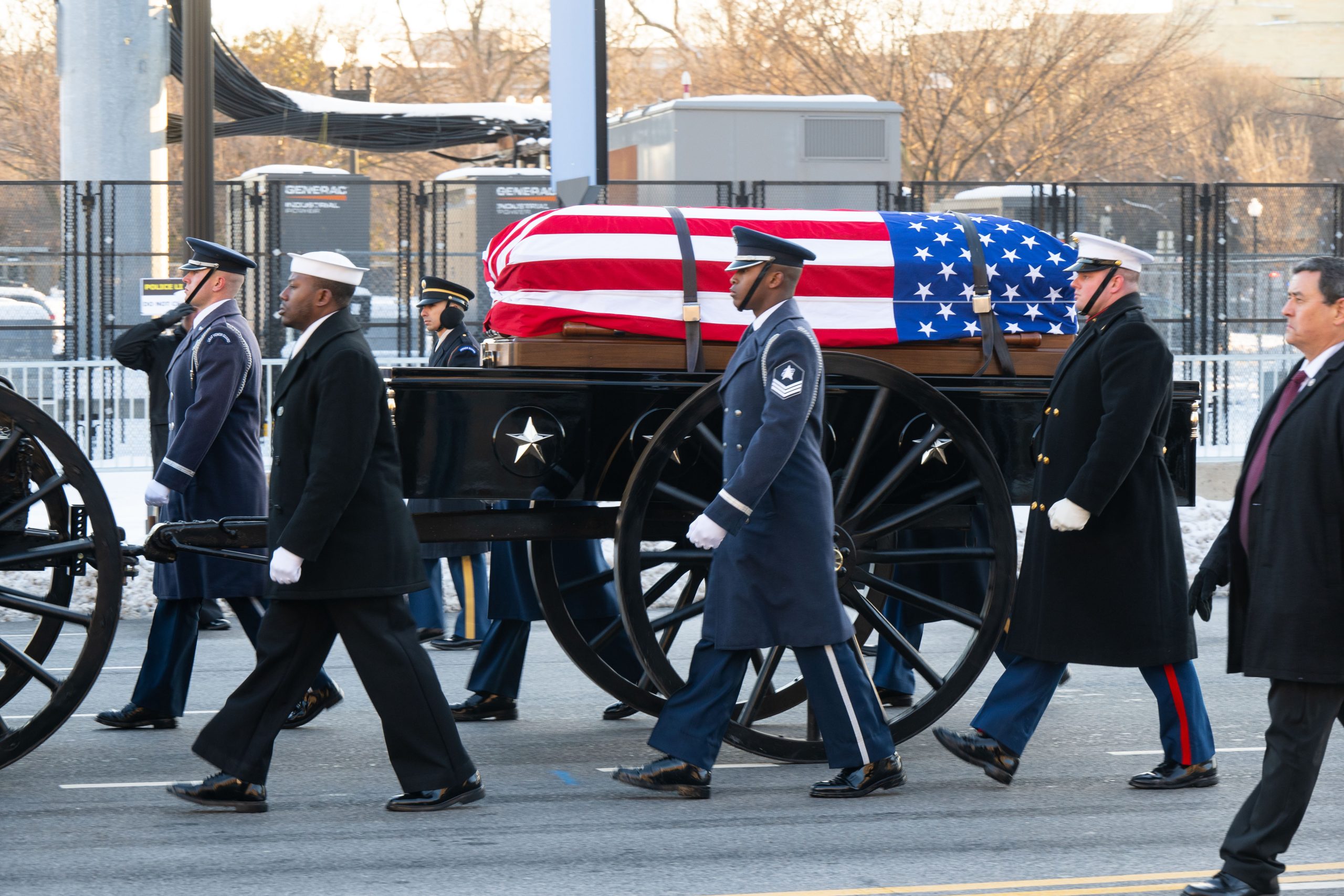
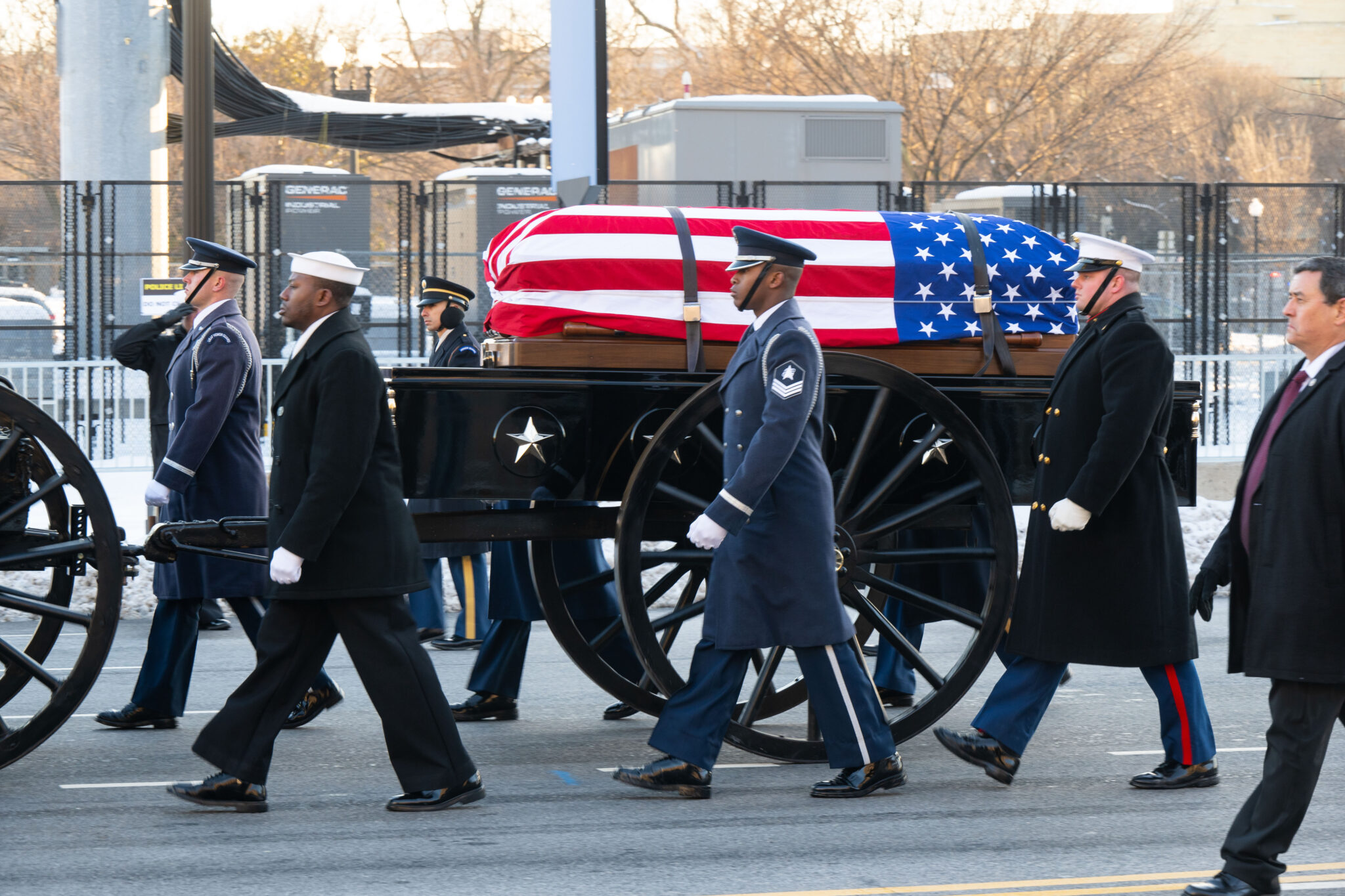
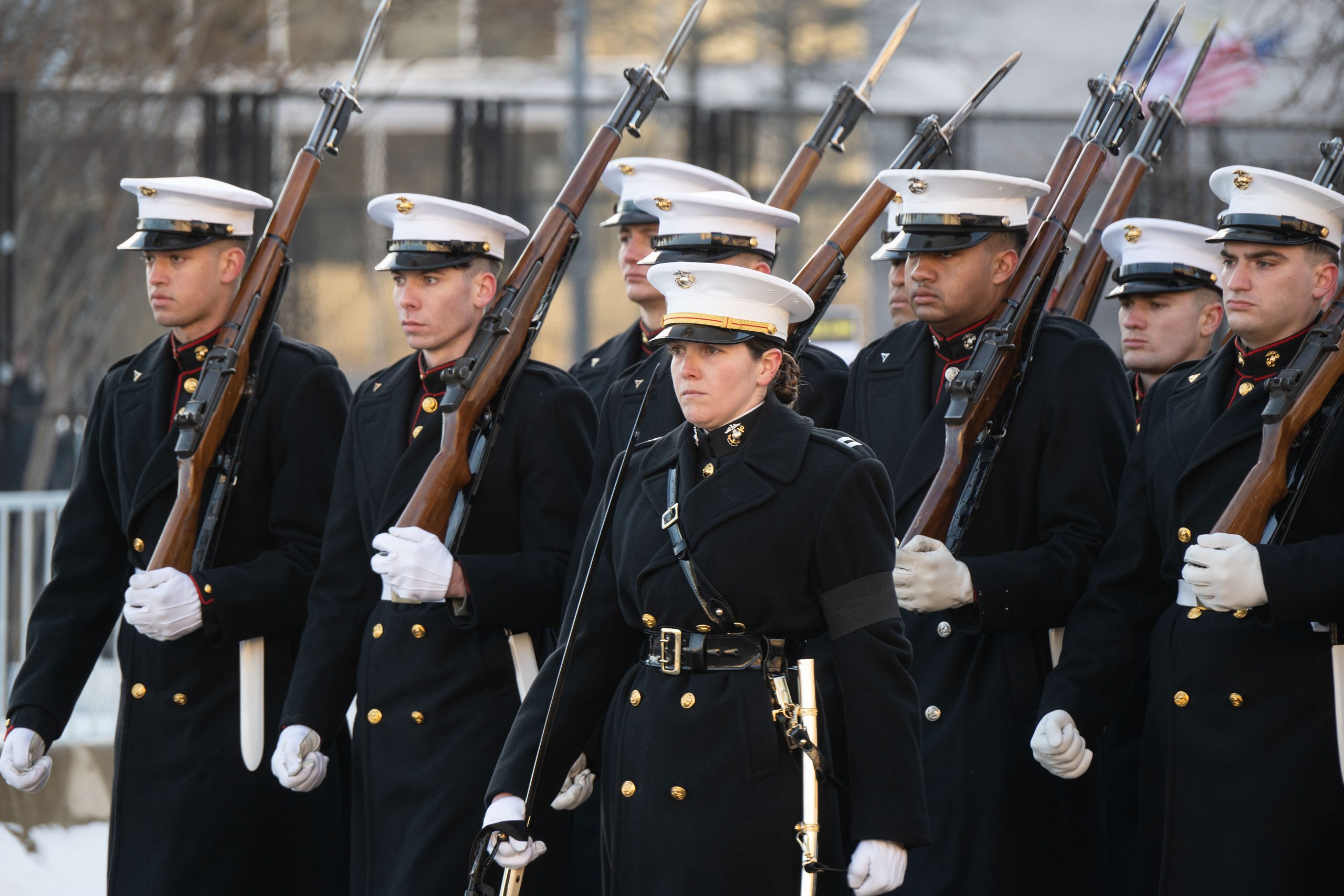
WASHINGTON — President James Earl “Jimmy” Carter Jr.’s final procession through Washington started Jan. 7 at the U.S. Navy Memorial, where his casket was loaded onto a horse-drawn caisson for transportation to the Capitol where he is lying in state.
The 39th president of the United States had requested the transfer be made at the Navy Memorial as he planned his own funeral. He will lie in state until Thursday, when the state funeral will be held at the Washington National Cathedral.
Carter, who passed away in December at age 100, was the fifth consecutive president with prior Navy service, according to the U.S. Naval History and Heritage Command. He received an appointment to the academy and became a member of the class of 1947, although he completed an accelerated wartime program and graduated in 1946, commissioning as an ensign.
He served first on the USS Wyoming, a battleship that had been converted to a floating laboratory for testing new electronics and gunnery equipment, according to the command.
After two years of surface ship duty, Carter applied for submarine duty and was assigned to the USS Pomfret and later the USS K-1, and in 1952 joined the new program to create nuclear-powered submarines. According to the Naval History and Heritage Command, Carter served with the U.S. Atomic Energy Commission’s Naval Reactors Branch, aiding in the design and development of nuclear propulsion for Navy ships and submarines.
Carter was preparing to become the engineering officer for the nuclear powerplant for the USS Seawolf (SSN 575), one of the first nuclear-powered subs, and helped set up training for the enlisted Sailors who would serve on the boat.
However, his father, James Earl Carter, passed away, and Carter resigned from the Navy to return to Georgia to manage the family peanut farm and, eventually, to launch his political career.
His naval roots were never forgotten, and the Seawolf-class USS Jimmy Carter (SSN 23) is named for him, as is an academic hall at the U.S. Naval Academy.
“His legacy and beliefs are imbued in the Sailors that set sail aboard the USS Jimmy Carter and walk the halls of the newly renamed Carter Hall at the United States Naval Academy,” Admiral Lisa Franchetti, the chief of naval operations, said in a statement upon Carter’s death.
“President Carter’s life of service will continue to be an example for us and help us navigate our course. His work is finished, but the U.S. Navy’s work continues. President Carter, we have the watch.”