


Imagine if in 10 years the U.S. Department of Defense had one million aircraft, drones and other platforms powered by artificial intelligence. And, what if by 2045 that number had increased to 100 million?
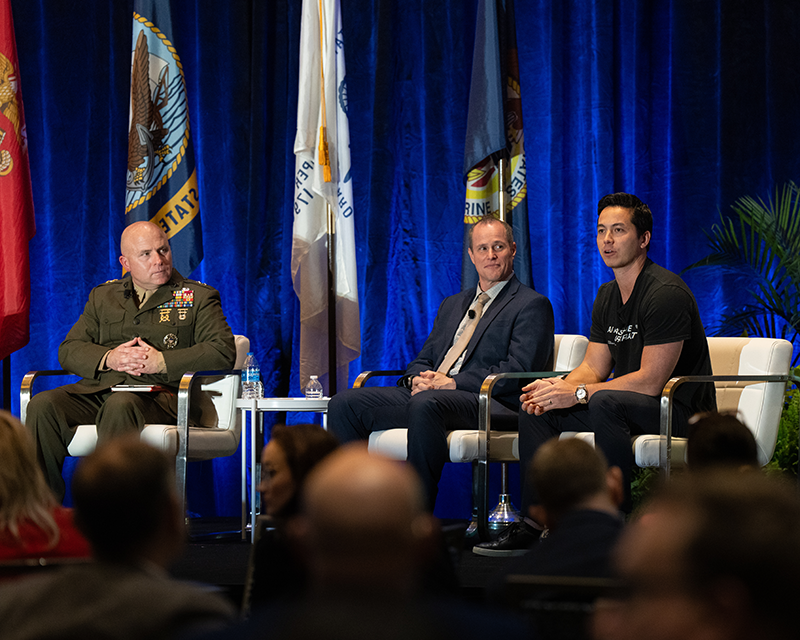
That’s the vision of former Navy Seal Brandon Tseng, who co-founded the AI technology company ShieldAI in 2015. Tseng, along with representatives from the Navy, Marines and Coast Guard, discussed how best to incorporate AI into the DoD during the Monday afternoon session “Transforming Defense: The Power of AI and Robotic Autonomous Systems.”
Tseng believes for the armed forces, AI is as game-changing as nuclear and stealth capabilities. He said AI can currently accomplish about 98% of DoD missions and urged the audience to envision a DoD that’s no longer limited by the number of human personnel.
Of course, that can be easier said than done.
Rear Admiral Kurt Rothenhaus, chief of naval research, said the Navy and its fleet commanders are “hungry” to leverage industry AI capability for war fighting, readiness and operations, but there’s “a lot of learning and discovery that still needs to be done. We want to learn not just the kit, but also how you approach problem-solving.”
Rothenhaus said the Navy recognizes AI is like electricity — ubiquitous. But a key issue regarding naval AI operations is that “we operate in one of the harshest environments in the world, in the ultimate no-fail world of war at sea. It’s a different frame of reference than the commercial sector.”
Major General Farrell Sullivan, director of the USMC’s Capabilities Development Directorate and Department of Combat Development and Integration, said AI could help with two key USMC operational problems: supporting the closing of kill webs and making unmanned systems more survivable in a contested environment.
In the Coast Guard, Brian Campo, USCG chief data and artificial intelligence officer, said AI can be integrated into many missions that rely on massive amounts of data, including search and rescue and managing ports.
“We don’t have a lot of autonomous capabilities, but we are expanding,” he said. “We have a need and thirst for data.”
Campo said the breadth of the Coast Guard’s missions is growing rapidly, beyond what even an expanded workforce can handle. He noted autonomous systems could operate in places where massive Coast Guard cutters can’t, and AI data collection could help commanders better decide how to engage a ship in port and conduct law-enforcement activities.
Shelf Life
But there are also concerns about incorporating more AI into DoD operations. Tseng addressed one of them, noting that costs will “come massively down” as AI becomes more widespread. He said in order for the DoD to become a “good buyer” of AI technology, it has to rethink purchasing a 20-year capability.
For instance, he said, the Air Force uses smaller time frames for AI purchases compared to fighter jet purchases. And the Army is trying to buy AI platforms every two years, because that’s the average shelf life of an AI system.
Campo said training personnel to use AI is another challenge.
“We can’t make an AI officer at the O5, O6 level in two to five years. How do we bring in and train talent?” he asked.
At the USCG Academy, Campo said the goal is to offer trainees the opportunity to automate the tasks they do every day, and build a governance framework that helps them embrace AI in their jobs.
He also urged AI vendors to think about how to deliver their products as services.
“I want to buy a capability; I don’t necessarily want to buy a product,” he said, noting the Coast Guard may prefer to buy data rather than the platform used to deliver it. “What I really would love to understand is how can industry deliver the service I actually care about without the services I don’t specifically have a need for?”
To better implement AI in the short term, Sullivan said he’s considering two main levers: making existing platform more lethal, survivable, integrated and affordable; and creating more disruptive capabilities.
“We need better software pipelines, training mechanisms and algorithms,” he said. “We have a sense of urgency to get after it. At the end of the day, AI is going to give a fire-team element the combat power of a battalion-sized element. Human-led operations and maneuvers are going to be massively augmented by AI.”