
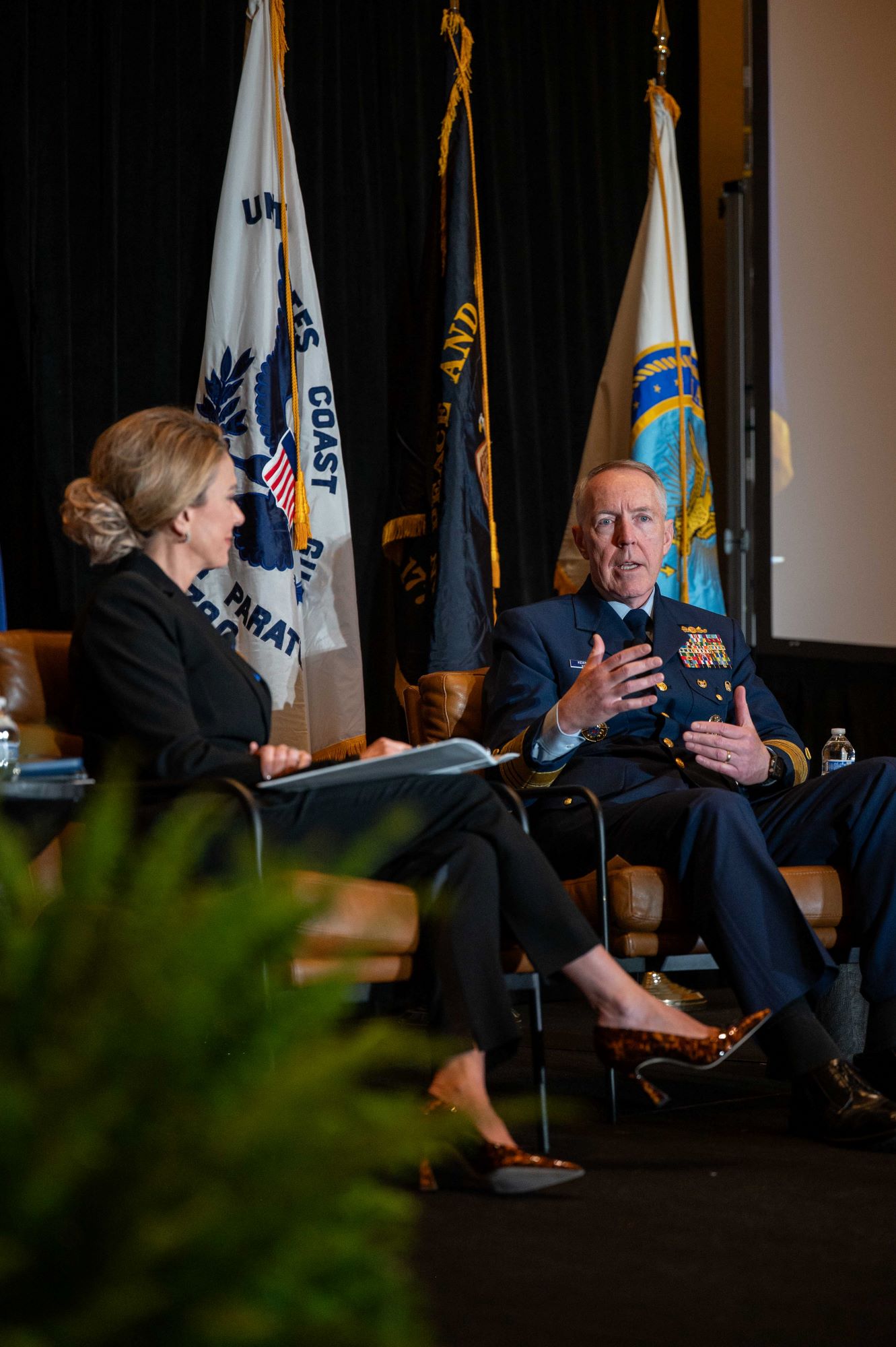


The U.S. Coast Guard is quickly allocating an unprecedented $24.6 billion funding infusion provided to the Department of Homeland Security agency in last year’s budget reconciliation bill. At the same time, the armed services branch is shuttered, caught in the political crossfire over the actions of another DHS entity, Immigration and Customs Enforcement.
In describing this bizarre situation to a Sea-Air-Space 2026 audience on April 22, the 28th Coast Guard Commandant, Admiral Kevin E. Lunday, looked to Charles Dickens, who opens “A Tale of Two Cities” with the famous lines, “it was the best of times, it was the worst of times. …”
“We want to get those worst of times out of here,” he said in a conversation with ABC News correspondent Kyra Phillips on the closing day of the conference. Lunday urged Congress to fund the Coast Guard to “ensure our readiness but pay our people.”
Citing an emergency authority, the White House directed DHS to cut checks to personnel across the agency, including affected members of the Coast Guard, a temporary solution that most agree is not a substitute for annual appropriations.
Promise Amid the Peril
Despite the funding stoppage, Lunday said it’s still an “amazing time for our service.”
That’s in part thanks to the nearly $25 billion from the reconciliation bill, which is funding long-deferred shipbuilding and modernization efforts at the agency, which Lunday has led since Jan. 15, 2026.
Lunday said the Coast Guard relies on an aging fleet — including 50-year-old cutters — to conduct much of its work. For instance, this year these stalwart vessels freed frozen shipping lanes in the New England, New York and Great Lakes regions so ships could deliver essential cargo like home heating oil and other goods.
“Keeping commerce moving is a constant, constant effort,” he said. “In fact, it’s one of the most important, but maybe one of the things that is not aways seen.”
These operations have continued amid a decades-long downward spiral in readiness, Lunday said. He said the Coast Guard requires about $20 billion in annual funding but has in recent years received just under $13 billion per year.
To reverse that trajectory, Lunday’s team knew they needed to get the new cash out the door quickly. To do this, the service created an acquisition “super highway” to accelerate the shipbuilding acquisitions process.
The Coast Guard has already obligated $9 billion of the new money, with three new heavy icebreakers and 11 new Arctic security cutters set to roll off the U.S. shipyards starting in 2028.
“No one is moving that fast,” Lunday said.
Topline Annual Appropriations
However, it’s critical that Congress also support the president’s fiscal 2027 budget request of $15.6 billion to build on the one-time cash injection from the reconciliation bill, he said. The plus-up in yearly funding is necessary for homeports, hangars, facilities and other infrastructure to support the roughly 100 new assets funded through the bill, he said.
That includes funding to train, hire and support the families of roughly 1,300 additional personnel needed to crew the new vessels.
“And the ’27 budget request goes a long way to do that,” he said. “But we’re going to need to continue to see that topline growth, not only in the operating funds but continued investments in capital assets to be able to meet the demands of the American people.”
The Coast Guard is currently comprised of about 41,000 active-duty military and 8,700 civilian employees, 6,200 reservists and 26,000 auxiliary volunteers.
Compared to its size, Lunday said the Coast Guard delivers “unprecedented value” to the nation, saving lives, protecting the maritime borders, keeping trade routes safe and free, and providing disaster assistance worldwide. Some of these operations in 2025 involved:
- Saving 5,220 people and assisting more than 19,000 through search-and-rescue missions.
- Diverting a four-person crew far inland to help respond to the July 4 Central Texas floods, which ultimately killed 135 people.
- Deploying USCG cutters Storis, Healy and Waesche to protect U.S. sovereignty in the Arctic by chasing off five Chinese research vessels that traversed U.S. waters.
- Ensuring the safe maritime passage of $1.8 billion tons of cargo, a 13% annual increase.
- Seizing a record-breaking 511,000 pounds of cocaine trafficked to the United States by cartels.
As the 236-year-old service begins its promising next chapter, Lunday said he hopes the funding lapse can end so he can refer to a different Dickens’ tome: “Great Expectations.”