
Sea-Air-Space: Fighting from the MOC Requires Standardization, Speakers Say


Brett Davis is a lifelong journalist and writer with extensive experience writing about defense issues and technology. He studied journalism and photography at the University of North Alabama in his hometown of Florence and then earned a master’s degree in journalism from the University of Missouri. He worked for a dozen years as Washington Correspondent for the Huntsville Times newspaper, then became editor of Aerospace Daily & Defense Report, published at the time by McGraw-Hill. He served as content manager for Backfence.com, a pioneering local journalism website, was editor of Unmanned Systems magazine at the Association for Uncrewed Vehicle Systems International and editor in chief of Inside Unmanned Systems magazine for Autonomous Media. He previously served as Deputy Editor of Seapower magazine. He’s also a fiction writer: His latest, The Moon Above, is the story of a Tuskegee Airman published by Scarsdale Publishing.
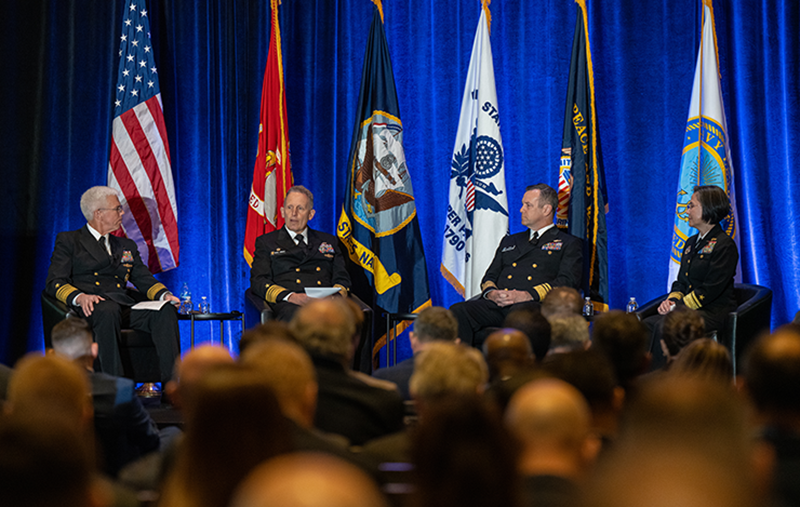
The concept of “fighting from the MOC” will require much greater standardization of Maritime Operations Centers, in training, equipping, resupplying and data management and protection, speakers said at a panel April 7 at Sea-Air-Space.
The MOCs are purpose-built for fleet commanders, but that makes them difficult to coordinate, said Vice Admiral Karl Thomas, the director of Naval Intelligence, who moderated the Monday panel on “Fighting from the MOC.”
“We would like to have them all configured in a standard manner … so we can modernize them in a better way,” Thomas said. “There’s a little tension in that, but it’s a good tension. In the pace of the fight today, we need to modernize.”
MOCs are how the Navy executes fleet-level warfare and facilitates mission command at lower echelons, but the Navy is seeking to use them as the centerpiece for the type of distributed warfare likely in the vast Pacific.
“We will treat and resource MOCs like the warfighting systems that they are, capable of operating on a decentralized and global battlefield just like all other weapons systems,” the Navy’s 2024 Navigation Plan says.
Vice Admiral Michael Vernazza, commander of Naval Information Forces, said his team is working with Navy personnel officialsto conduct a manpower review of each MOC, starting in the Pacific, focusing on the exact manning each will need to carry out the seven joint tasks outlined in the chief of naval operation’s Navigation Plan.
“By 2027, all fleet headquarters, starting in the Pacific Fleet, will have ready MOCs certified and proficient in command and control, information, intelligence, fires, movement and maneuver, protection, and sustainment functions as assessed by our MOC Training Teams,” the NAVPLAN says.
Investments
Admiral Susan BryerJoyner, director of the Warfighting Integration Directorate, said the main investment that needs to be made to be ready for 2027 is cloud infrastructure and supporting “zero trust” technology to make sure data going into and from MOCs is protected, and available to commanders who need it.
Data visualization doesn’t need to be standard, “but what does need to be standard is the data that underpins it,” BryerJoyner said.
“Every commander should not be able to pick and choose what data he or she wants to use for a specific warfighting function, because as soon as you start to add that variability in, now different commanders are going to see different things and come to different conclusions,” she said.
“This shift from MOC as a commander’s personalized way of fighting to a more standardized way of feeding into the joint force, is the journey that we’re going on now,” she said.