
Sea-Air-Space: USMC is Ready to be Tip of the Spear, but Needs Steady Funding, Smith Says


Brett Davis is a lifelong journalist and writer with extensive experience writing about defense issues and technology. He studied journalism and photography at the University of North Alabama in his hometown of Florence and then earned a master’s degree in journalism from the University of Missouri. He worked for a dozen years as Washington Correspondent for the Huntsville Times newspaper, then became editor of Aerospace Daily & Defense Report, published at the time by McGraw-Hill. He served as content manager for Backfence.com, a pioneering local journalism website, was editor of Unmanned Systems magazine at the Association for Uncrewed Vehicle Systems International and editor in chief of Inside Unmanned Systems magazine for Autonomous Media. He previously served as Deputy Editor of Seapower magazine. He’s also a fiction writer: His latest, The Moon Above, is the story of a Tuskegee Airman published by Scarsdale Publishing.
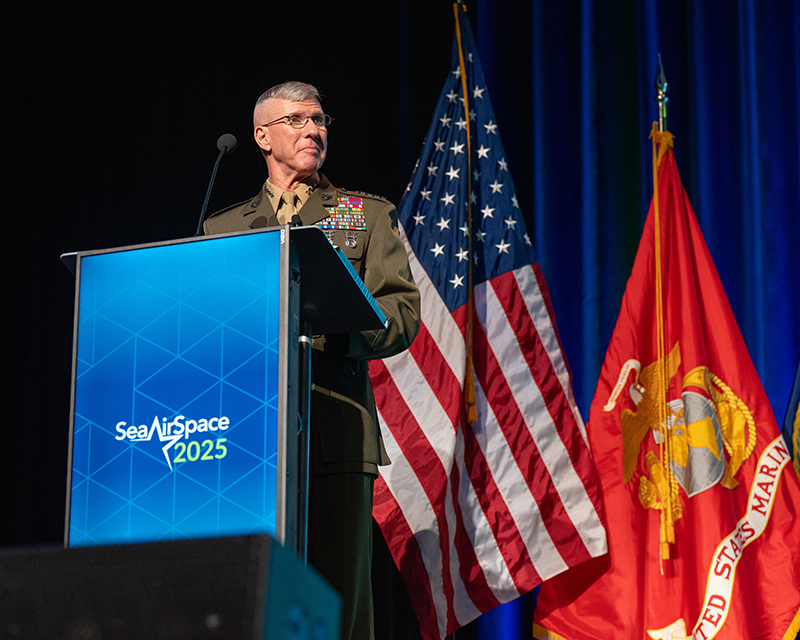
Sea-Air-Space. Photo credit: Dan Goodrich
The U.S. Marine Corps is expanding its expeditionary capability and investing heavily in neglected resources to improve its warfighting prowess and the lives and effectiveness of Marines, but unpredictable funding from Congress is making that difficult, the service’s leader said April. 7.
U.S. Marine Corps Commandant General Eric Smith was the luncheon keynote speaker at Sea-Air-Space and described the tools and constructs the service is using to project forces.
“I’ll begin with what makes the Navy and Marine Corps team the premier expeditionary fighting force on the planet,” he said. And that is the ARG/MEU, the Amphibious Ready Group/Marine Expeditionary Unit. An Amphibious Ready Group with an embarked Marine Expeditionary Unit is the coin of the realm,” he said. “It’s the Swiss Army Knife of the DoD inventory.”
His top priority, he said, is restoring a “3.0 MEU presence worldwide.” That means one ARG/MEU off the East Coast, handling the Mediterranean and the coast of Africa, one off the West Coast, handling the Indo-Pacific, and the “episodic deployment” of a MEU out of Okinawa, Japan. Three such ARG/MEUs is the minimum, he said, while the demand signal is for 5.5.
MEUs include light infantry, artillery, light armored reconnaissance, combat aviation, combat service support, medical support and command and control, and “operate as one. They blend themselves into a chainmail fist,” he said.
The Amphib Fleet
One challenge for the Marines is reconstituting its amphibious ship fleet, which he said the USMC allowed to atrophy as it turned its attention to combat in Iraq in recent years.
“We didn’t look back at our amphibs,” he said. They weren’t maintained because they hadn’t been used in a decade, but “without those ships, Marines can’t get to the fight.”
The Corps has also been investing in equipment such as the AN/TPS-80 Ground/Air Task-Oriented Radar, or G/ATOR radar, and the Navy/Marine Corps Expeditionary Ship Interdiction System (NMESIS), a remotely operated missile battery, as well as MADIS, the Marine Air Defense Integrated System, which provides the service’s first organic air defense system.
“We used to be armed with a Stinger [missile], and that is not enough to get it done against the PRC,” he said, referencing China.
Barracks Spending
The USMC is also moving to address longstanding issues with its infrastructure, namely rebuilding crumbling barracks as part of Barracks 2030, which Smith described as a “heavy lift” that will cost $5 billion over the five-year defense program.
It’s difficult to plan such long-term efforts — 11 barracks renovations were started last year with another dozen planned this year — without steady funding. Members of Congress are supportive of these and other efforts, Smith said, but the reliance on continuing resolutions instead of passing new funding bills causes problems.
“I’ll stay out of politics,” he said. “But I will say we need predictable, on-time funding that only Congress can provide. Meaning, continuing resolutions aren’t continuing anything, they stop our progress.”