
USSOCOM Upgrades Personal Diver Equipment
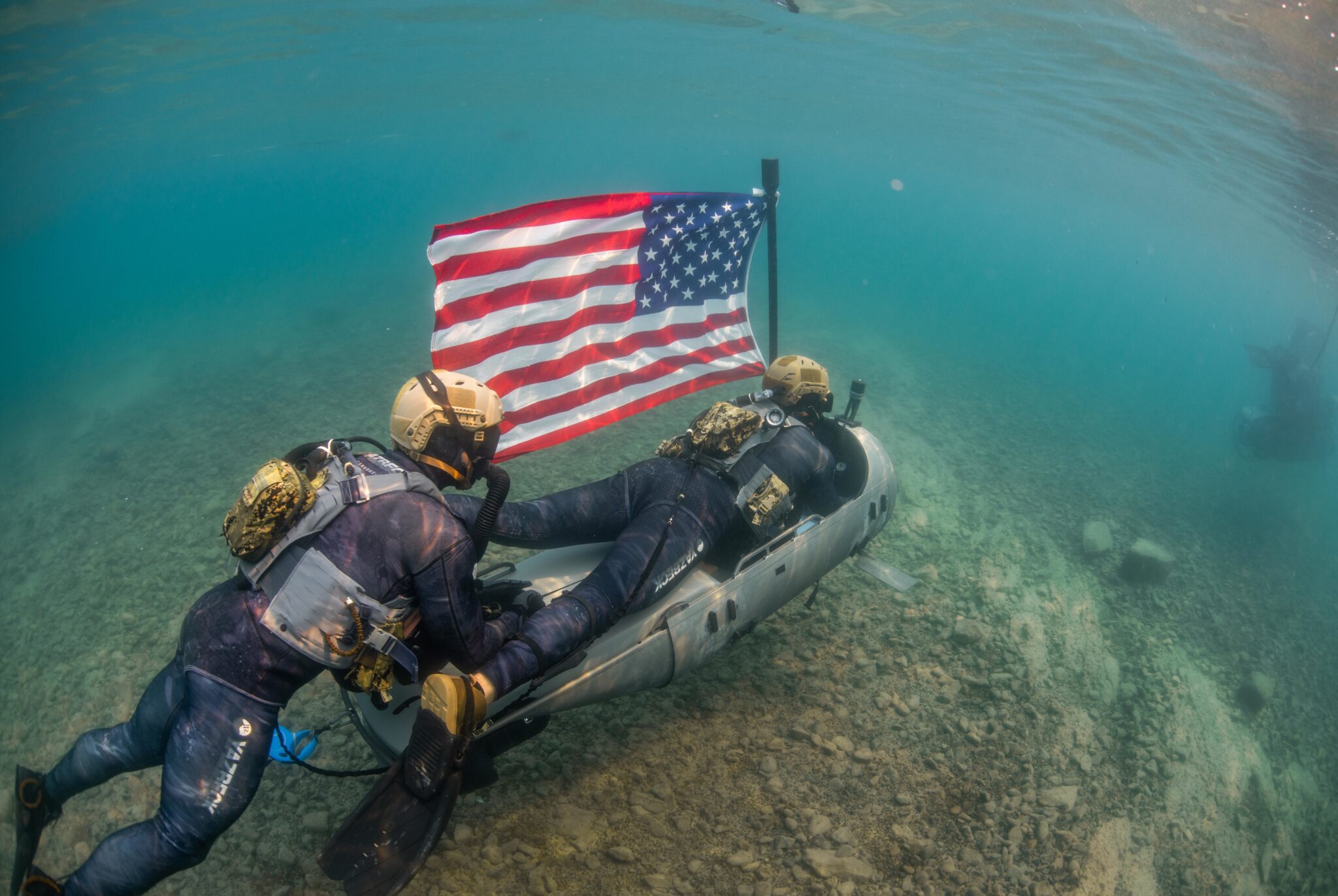


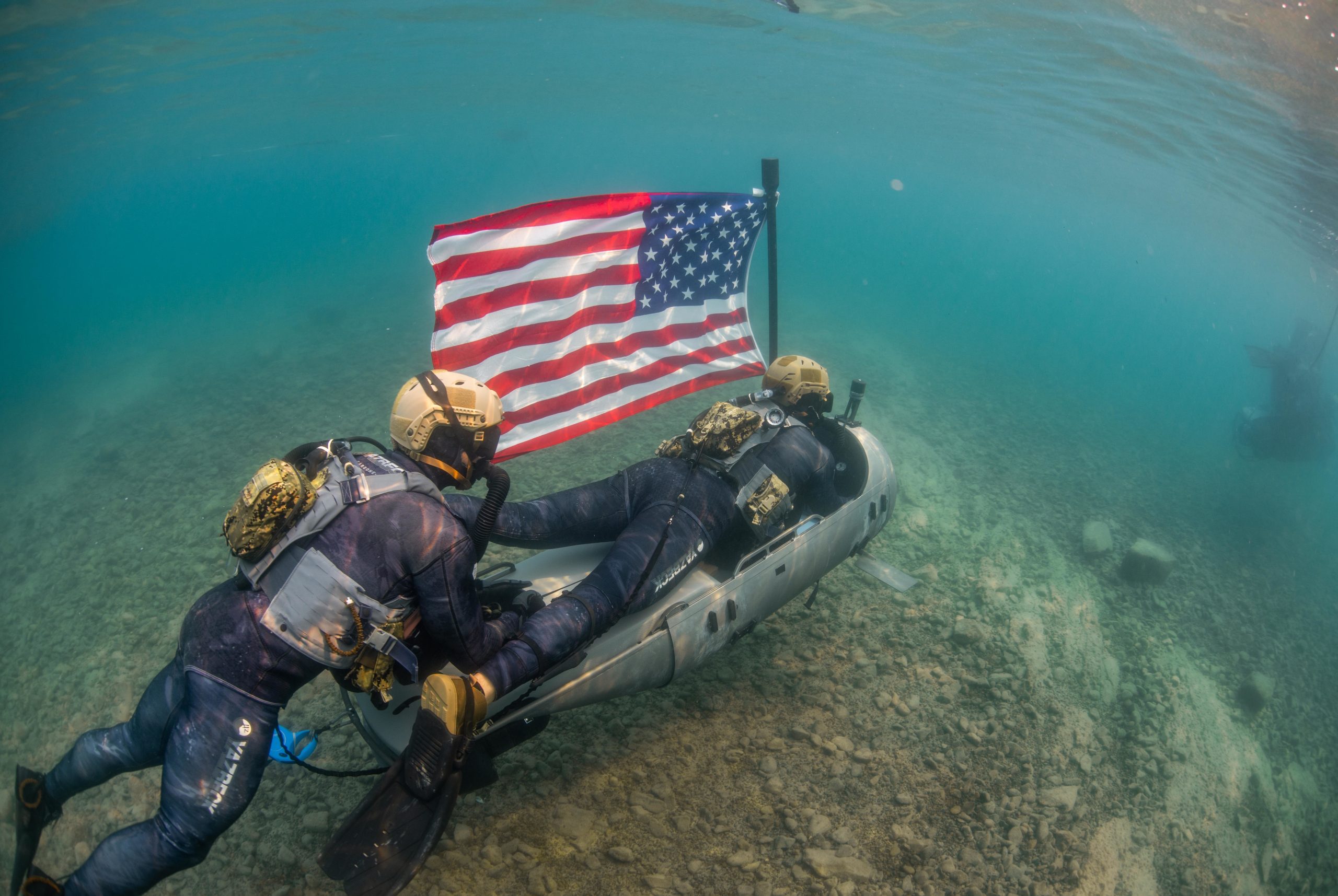
U.S. Special Operations Command is upgrading its Special Operations Forces’ personal diving equipment.
“Technology for the combat diver has advanced significantly and SOF continues to enhance diver capabilities to maintain an agile and lethal combat diving force,” Lieutenant Commander Kassie Collins of USSOCOM said in response to a question from Seapower.
The SOF Combat Diver program (under U.S. Special Operations Command PEO Maritime) consists of maritime environmental protection (free diver heating and cooling, full face masks, and chemical, biological, radiological, and explosive protection), life-support systems (underwater breathing apparatus, treatment systems, and decompression systems), diver navigation (handheld digital navigation and integrated navigation), diver propulsion (collective, hands-free), underwater communication (acoustic, optical, and diver-to-host) and signature management (equipment signature reductions and signature detection), Collins said.
“Early wins for the SOF Combat Diver program include digitizing legacy navigation and equipping energized propulsion devices in lieu of fins. As a result, the program has been able to rapidly accelerate development and fielding of navigation and propulsion devices. The SOF Combat Diver program also continuously evaluates battery technology to ensure safety and maximize endurance. Currently, this program does not have a requirement for drones or AI [artificial intelligence].”
Because many USSOCOM programs are generally classified, USSOCOM didn’t provide equipment specifics to the categories.
For Diver Propulsion, a search of SAM.gov., the official U.S. federal government contracting website did provide some details. In the summer of 2025, the Naval Special Warfare Center was looking into acquiring the Patriot3 Brand Jetboots V6 Diver Propulsion Device, essentially a low-noise, low-weight brushless motor ducted thruster propeller strapped to a diver’s thighs. The hands-free Jetboots provide 40 pounds of thrust and increase a special operations diver speed by around four knots at a depth of 300 feet and a range of a dozen miles on two batteries, or one to six hours of battery life.
TheWarZone website reported U.S. Navy SEALs having Jetboots since July 2020, but Jetboots was conceptualized and patented in 2013, so USSOCOM could be seeking supply support and maintenance in addition to new Jetboot replacements. A $10 million dollar contract was awarded to Patriot3 Inc. that runs through 2027.
For Diver Navigation, USSOCOM is working with Safety and Security International (SSI) regarding its Tactical Diver Readiness Assembly. This increases special operations divers’ situational awareness and rapid deployment in maritime and expeditionary environments by combining the functions and features of a mission critical multi-function dive watch with a modular load carriage and safety components to provide advanced underwater navigation instrumentation and real-time dive diagnostics in MOLLE-compatible pouches.
The navigation devices can be made digitalized, smaller and lighter, while still incorporating GPS features, real-time diving diagnostics, and advanced underwater navigation instruments.
Further investigation into SAM.gov. yields a request for information on underwater communications technologies that are not radio frequency based, as well as for power sources focused on power-harvesting technologies instead of batteries or connected power sources. The current status of USSOCOM’s underwater communications technologies and novel power sources is unknown.
The 2019 USSOCOM RFI also seeks improvements in human performance in harsh maritime conditions for extended operating periods “with or without personal protective equipment,” to:
- Reduce the potential of musculoskeletal injuries related to combat diving
- Improve combat diving-related physical performance capabilities
- Enable continuous physiologic monitoring of diver biometrics in sea water at depths greater than 90 feet for periods of up to or greater than 72 hours
- Provide a variety of nutrition and hydration products for consumption while underway
- Manage bodily functions while underway
- Provide force resistance equipment for confined environments
- Reduce cognitive deficits related to prolonged undersea exposure
- Provide active heating/cooling protection in the water column.