
Navy, Industry Working to Surge Capability as 2027 Draws Closer


Brett Davis is a lifelong journalist and writer with extensive experience writing about defense issues and technology. He studied journalism and photography at the University of North Alabama in his hometown of Florence and then earned a master’s degree in journalism from the University of Missouri. He worked for a dozen years as Washington Correspondent for the Huntsville Times newspaper, then became editor of Aerospace Daily & Defense Report, published at the time by McGraw-Hill. He served as content manager for Backfence.com, a pioneering local journalism website, was editor of Unmanned Systems magazine at the Association for Uncrewed Vehicle Systems International and editor in chief of Inside Unmanned Systems magazine for Autonomous Media. He previously served as Deputy Editor of Seapower magazine. He’s also a fiction writer: His latest, The Moon Above, is the story of a Tuskegee Airman published by Scarsdale Publishing.
As the U.S. military braces for a potential conflict with China in 2027, maritime defense and industry leaders alike are trying to get the most out of the existing fleet while planning for a more capable future fleet with a mix of manned and uncrewed platforms.
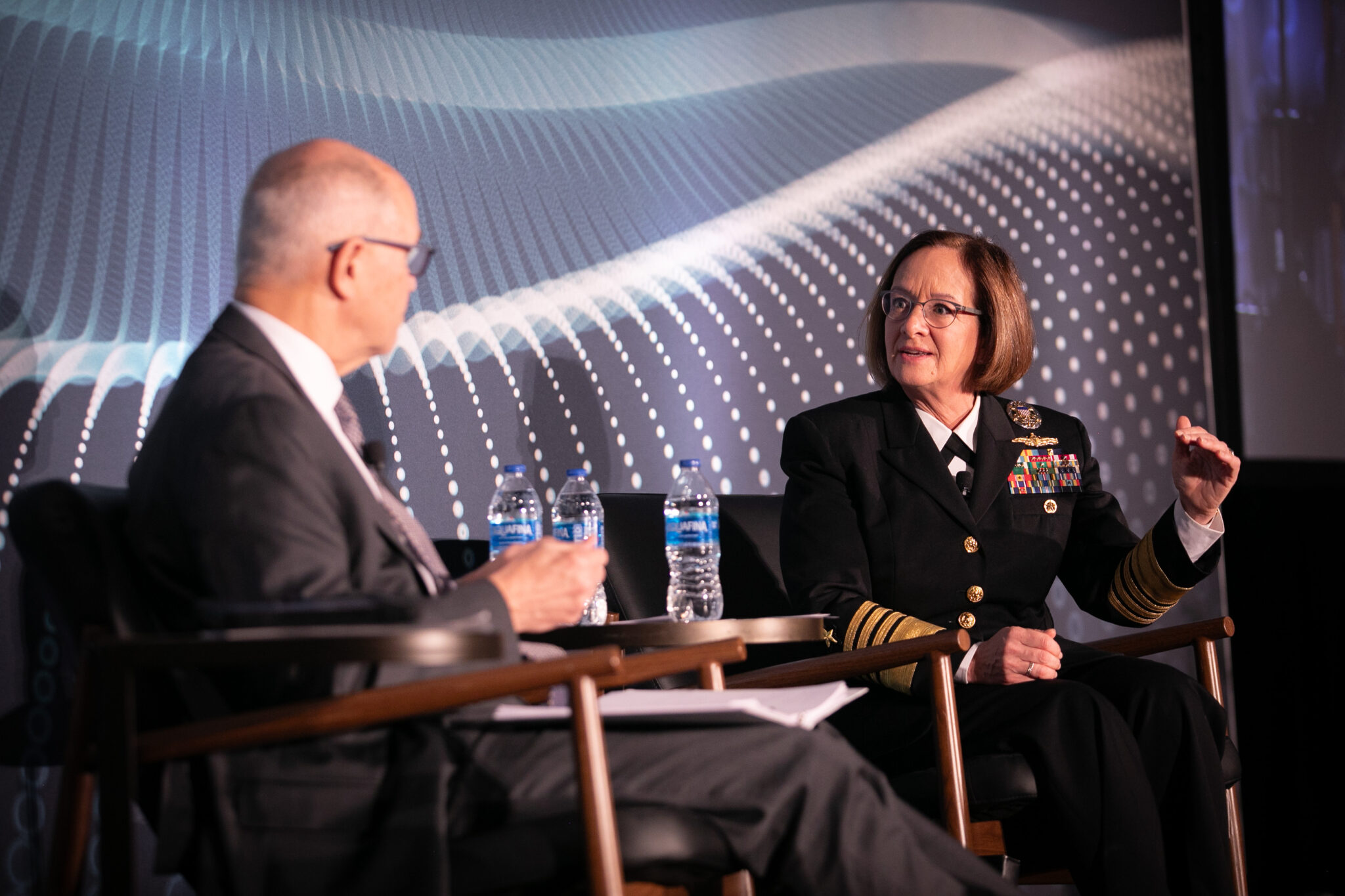
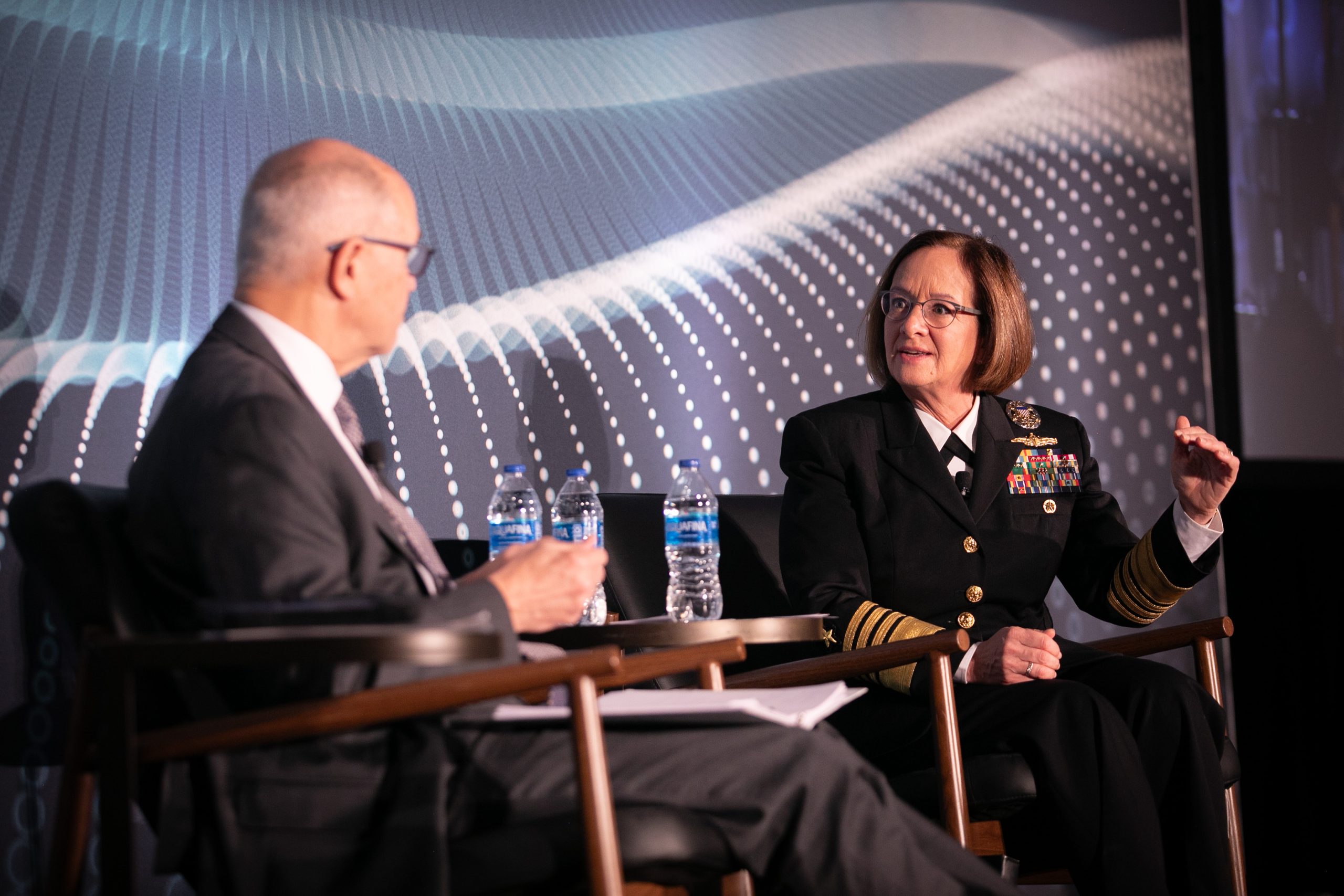
“The countdown clock in my office continues to tick away and it tells me when I walked in today that there are 716 days left until 1 January, 2027. There is no time to waste,” Chief of Naval Operations Admiral Lisa M. Franchetti said this week at the Surface Navy Association’s annual symposium, referring to a year when Chinese President Xi Jinping has reportedly told his generals to be ready for war.
“The People’s Republic of China is our pacing challenge and presents a complex multi-domain and multi access threat,” Franchetti said. “And I’m eyes wide open that the challenge posed by the PRC to our Navy goes well beyond just the size of the PLAN [People’s Liberation Army Navy] fleet. It includes gray zone and economic campaigns, expansion of dual use infrastructure like airfield and dual use forces like the Chinese maritime militia and a growing nuclear arsenal.”
To counter that, and guard against the expected threat to Taiwan, Franchetti said she needs a larger fleet and one with more robotic and automated systems from programs such as the Replicator initiative, the rapid development effort NavalX and the Disruptive Capabilities Office.
From the Russian invasion of Ukraine to the Houthis in the Red Sea, “we are seeing the increase in use and effective adaptation of robotic and autonomous systems in every domain,” she said. “It’s abundantly clear that we need to both have these capabilities and have the capability to defeat ’em kinetically and non kinetically … the future of war at sea is neither fully robotic nor fully manned.”
Secretary of the Navy Carlos Del Toro, in his last address as SECNAV to the Surface Navy Association, agreed.
“…Our challenge is not only about maintaining naval superiority, but also ensuring that the U.S. military is prepared to confront the evolving threats that are opposed by the People’s Republic of China, especially in the realms of advanced technology, maritime claims, and military modernization,” he said. “Much like President Kennedy’s recognition of the need for modernized nuclear deterrent, today’s Navy and Marine Corps must continue to adopt, leveraging both man and unmanned capabilities to counter the PRC’s growing naval and technological advances.”
Admiral Daryl Caudle, commander of Fleet Forces Command, has the job of training and equipping the fleets that will need to contain China’s potential military expansion.
“The speed of modern warfare, combined with ever-shrinking indications and warnings windows, means we won’t have the luxury of long lead times to bring the full capabilities of our fleet to bear,” Caudle said in his keynote address to the SNA.
“Every day, about 100 [U.S. Navy] ships are deployed around the globe. Furthermore, about 100 ships are in lengthy depot maintenance availabilities that would take weeks, if not months, to close out just by buttoning up all the existing work and returning systems to service. This leaves the last 100 ships that are not deployed nor in depot, and the question — can we do more with those ships to make them ready to flow into combat? The answer is hell yes, and we are,” Caudle said.
That includes making use of the Combat Surge Ready certification for ships, a formal process and designation for getting ships on the Response Plan watchbill.
Efforts like the ongoing Shipyard Infrastructure Optimization Program, or SIOP, won’t add a lot of ship mass to the Navy by 2027, Caudle said, but the combat surge effort can up those numbers in the short term.
“When we sustain 80% Combat Surge Ready or better for all ships not in depot maintenance, the number of platforms ready to surge and flow into combat step-increases from around 100 to 180,” Caudle said. “…The goal of sustaining 80% Combat Surge Ready will require some new ways of thinking and may be uncomfortable for some, but we know our force structure will certainly not change between now and 2027 and will not significantly change over the next decade. Bottom Line: We must be constantly making ready ships not in depot or currently deployed.”
Industry Efforts
Getting more ships to the fleet requires having a large, well-trained workforce, something the maritime industry has been struggling with in recent years.
Christopher Kastner, CEO of shipbuilding giant HII, sat down with reporters on the eve of the SNA symposium to discuss how his company is trying to attract more workers, particularly more experienced ones, and dealing with an “almost arthritic” supply chain.
One way is by buying relevant suppliers. HII announced in December it has agreed to buy W International SC and Vivid Empire SC, South Carolina metal fabricators specializing in building structures, modules and assemblies for shipbuilders.
“We did that simply to increase capacity and increase throughput,” Kastner said. “We’re going to where the labor is, right? … We’re expanding into Texas, Louisiana, we’ve expanded in Norfolk, Virginia. You see this expansion in South Carolina. We’re going to where the labor is.”
Paying better wages for the shipbuilding workforce is also key, he said, and the Navy has taken steps to help do that for the submarine industrial base. It’s a key effort at a time when the gap between shipbuilding work and less demanding retail work has narrowed, making it harder to attract new workers.
“I definitely think there’s momentum, there’s recognition by the Navy, as you saw on the [defense budget] supplemental, that they want to address wages in the submarine industrial base. I don’t think it should be limited at the submarine industrial base, and it should be all of shipbuilding, [we] should be able to adjust wages to attract and increase talent into the industry.”