
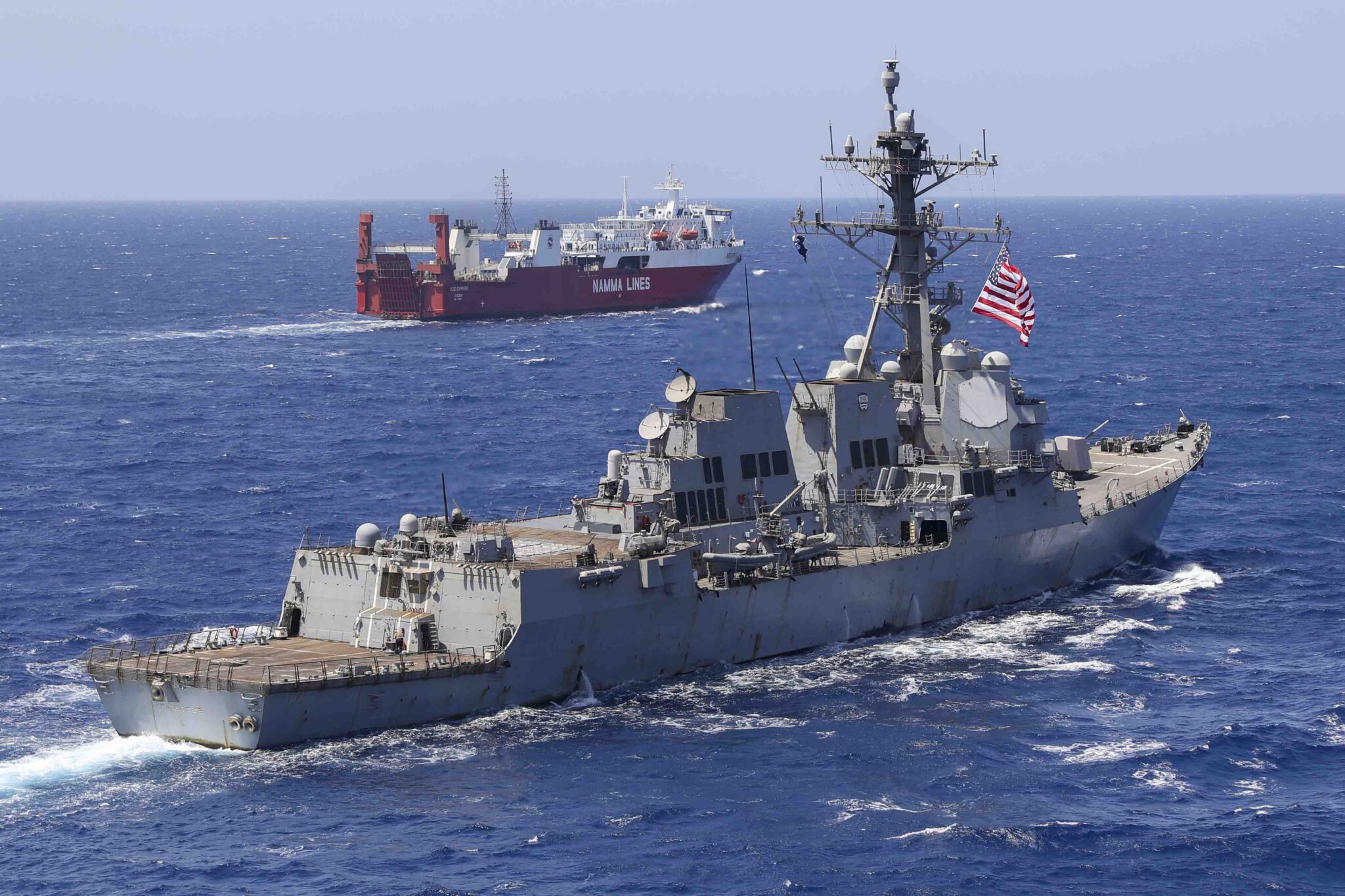


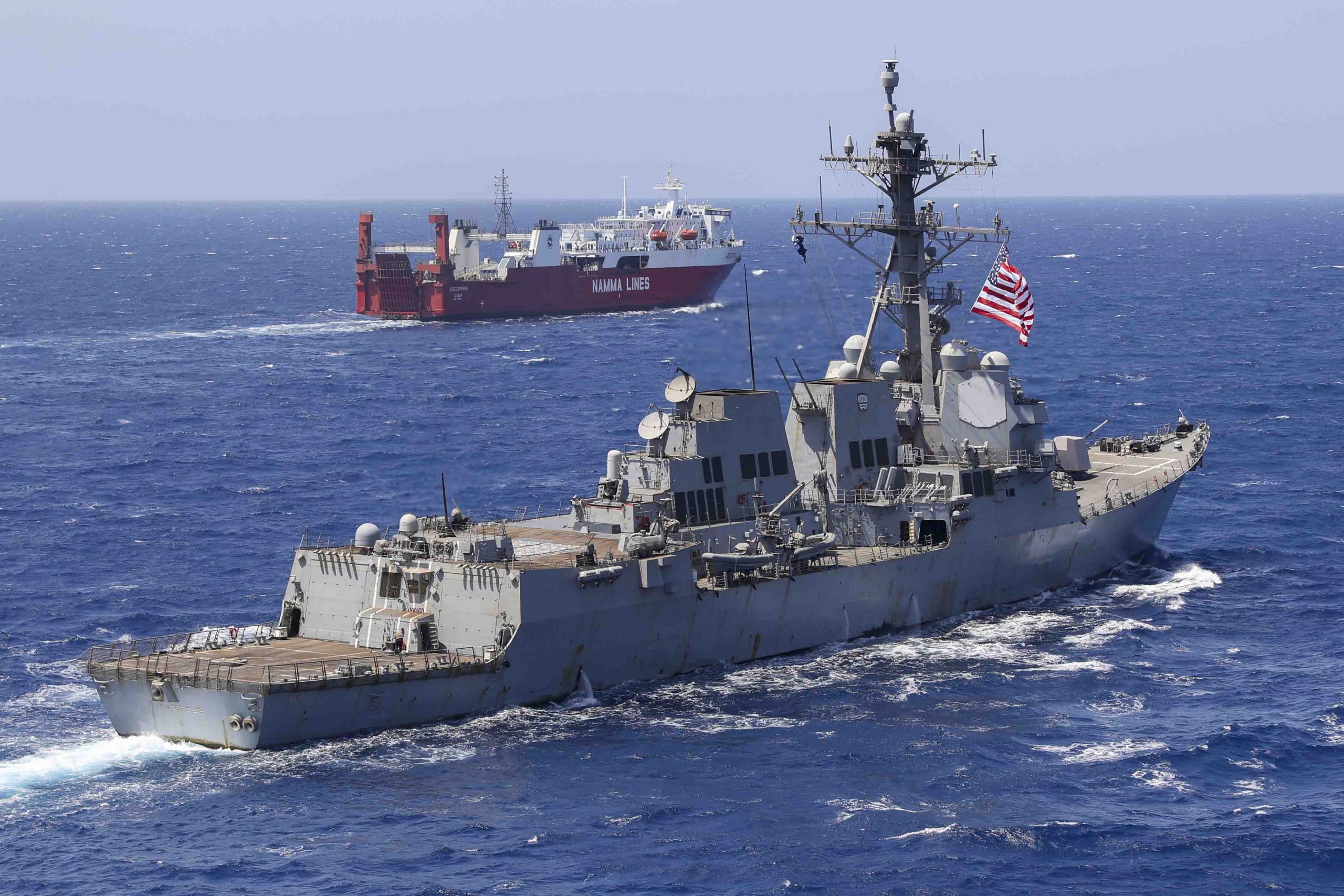
The Arleigh Burke-class guided-missile destroyer USS Truxtun (DDG 103), left, operates in the Red Sea, May 1, 2023, while supporting the Department of State’s efforts to evacuate U.S. citizens and others who have requested departure from Sudan. Credit: U.S. Africa Command
Deterring China and addressing other global security challenges require the U.S. Navy to evolve in key areas, including faster integration of robotics and autonomous capabilities, said Admiral Lisa M. Franchetti, the 33rd chief of naval operations, in the new 2024 Navigation Plan released in September.
“We know that robotic and autonomous systems, augmenting the multi-mission conventional force, will provide opportunities for us to expand the reach, resilience, and lethality of the combined manned-unmanned Navy team,” Franchetti said. “As we build that team for the future, we are working now on concept and requirements analysis for larger robotic systems, as well as the artificial intelligence applications that help us sense and make sense of a complex, information-centric battlespace.”
The plan comes amid a Pentagon push to accelerate artificial intelligence/machine learning (AI/ML) technologies in offensive and defensive applications in the joint force and across the armed services. But advancing Franchetti’s goal — one of seven fleet readiness targets the plan envisions reaching by 2027, when Washington expects China to be on a war footing — won’t be easy in a service that tends to focus on continuity versus change.
“When we think about AI and the Navy, one of the most important things is getting it on the ship,” Bill Rivers, a fellow at the Yorktown Institute and content strategist at Palantir Technologies, told Seapower. “So, it’s software onto hardware onto the ship [and] that requires an accreditation process, which takes time.”
Last year, the Department of Defense announced the Replicator initiative to speed up adoption of commercial technology in the military and national security space, particularly lower-cost unmanned capabilities. Led by the Defense Innovation Unit, a DoD office based in Silicon Valley, Replicator calls for quickly fielding more autonomous systems across multiple domains in part by cutting red tape and encouraging industry-defense partnerships.
In 2023, Navy Secretary Carlos Del Toro stood up the Disruptive Capabilities Office to invest in, adopt and scale cutting-edge hardware and software. Joining that office and reporting to Del Toro and Franchetti are two Navy task forces working on AI/ML: Task Group 59.1, which focuses on developing unmanned capabilities; and Task Force Hopper, focused on AI/ML.
Franchetti said in the Navigation Plan that the Navy already leads the joint force in operationalizing robotic and autonomous systems across numbered fleets and in Navy special warfare, in areas such as sensors and munitions. The Navy in 2024 established an enlisted Robotics Warfare Specialist rating and is growing robotics expertise in the officer corps.
The Navy has also in recent years worked on develop AI/ML capabilities in partnership with the DIU, an office established nearly a decade ago to incubate commercial technology solutions that address national security challenges. Recent DIU-Navy partnerships include Project AMMO, to develop machine learning operations tools to improve underwater threat detection. In 2022, DIU engaged five vendors — Arize AI, Domino Data Lab, Fiddler AI, Latent AI, and Weights & Biases — to develop various components of the capability.
There is also a collaboration with the Navy’s Project Overmatch to enable unmanned systems to operate in “disconnected, denied, intermittent, and/or limited bandwidth environments.” In January 2024, DIU awarded three vendors — Ditto, Syntiant, and HarperDC — prototype agreements to develop capabilities in areas such as synchronizing and distributing data to improve the operating picture and creating retrainable AI models that improve the effectiveness of unmanned systems.
In addition to Pacific threats and Houthi attacks, Franchetti noted, Russia’s ability to adapt to Ukrainian innovations on the battlefield demonstrated the need for a more agile Navy that can bring additional AI/ML-powered technologies to the fight.
“What’s needed now,” Rivers said, both in the Navy and across the defense enterprise, are “commanders who are willing to lean in, find these opportunities to battle test these capabilities, so that the carriers, the cruisers, boats can communicate back to maritime operations centers” and build out “how they would actually fight with these tools at the edge, on the worst day.”
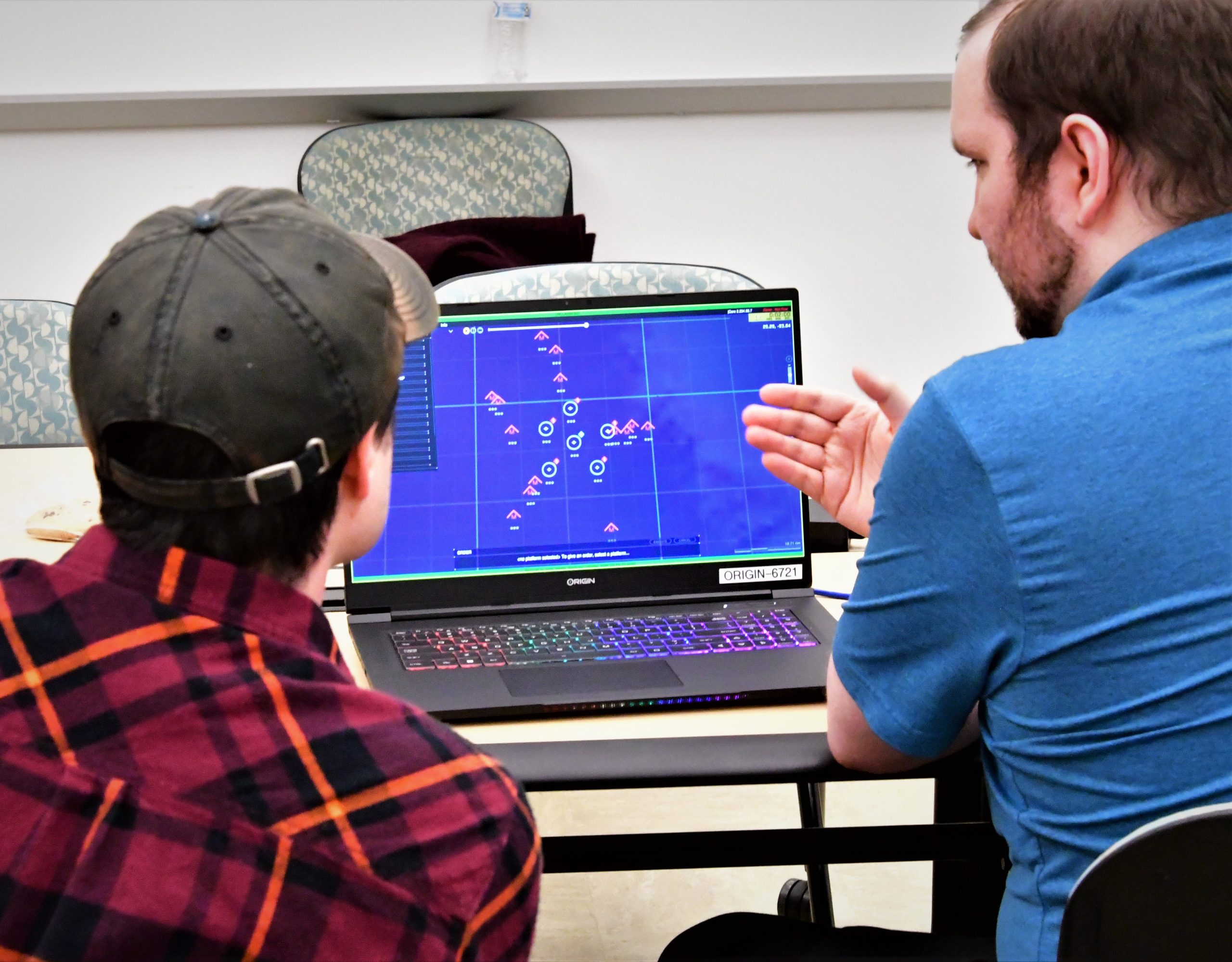
2023 Artificial Intelligence and Machine Learning Innovation Challenge at Dahlgren. The software demonstrated three different scenarios involving a multitude of ships and threat counts to challenge the students’ decision-making. Credit: Naval Surface Warfare Center Dahlgren Division | Morgan Tabor
He said software and AI can also serve a “powerful role” in improving defense manufacturing and maintenance through better use of real-time data. “There is no kill chain without the supply chain,” Rivers said. “It’s not just on DoD or the government to do this, it’s a whole-of-enterprise effort.”
However, compared with all other DoD components, the Navy spends the least on technology produced by new players in the defense field, according to the 2024 NATSEC100 report by the Silicon Valley Defense Group. These are firms that specialize in advanced computing and software, trusted AI and autonomy, space technology, advanced materials, and integrated sensing and cyber capabilities.
The report found the top 100 tech firms with defense experience received just $22 billion in federal funding and only $6 billion in DoD funding. (For context, the 2024 National Defense Authorization Act authorized over $874 billion in defense spending.) “Perhaps even more strikingly,” the report said, “81% of the total amount awarded by the United States government, and 65% of the DoD-awarded funding, went to a single company, SpaceX.”
Lieutenant Artem Sherbinin, chief technology officer for Task Force Hopper, called on industry to help the Navy close the digital technologies gap. In February remarks reported by National Defense magazine, he said a key “opportunity” for the field is the fiscal 2024 NDAA, which authorized around $11 billion in Navy commercial IT spending.
Emerging needs include tools to counteract adversarial unmanned systems, especially in light of reports that the Navy used $1 million missiles to defeat $100,000 Houthi drones threatening Red Sea shipping lanes.
“Do we need to find, or should we find, a more cost-effective way of downing, say, an inexpensive drone? Absolutely,” said Rear Admiral Fred Pyle, director of surface warfare division N96 in the Office of the Chief of Naval Operations, in a May 14 discussion with the Center for Strategic and International Studies. “And we’re working towards that, and we have some solutions that I can’t go into, but we are going to get after finding more cost-effective ways to address those lower-end threats.”
A Sept. 27 memo issued by Defense Secretary Lloyd Austin formalized this imperative, calling for the next phase of Replicator to focus on countering the threat of small uncrewed aerial systems to critical installations and force concentrations.
The Navy is testing directed energy and other types of counter-drone systems and taking other steps to foster partnerships with industry on AI/ML applications.
In March 2024, 600 representatives from government, academia, and industry attended the eighth annual Naval Applications of Machine Learning (NAML) workshop, hosted by the Naval Information Warfare Center. Attendees heard 150 presentations on efforts to use AI/ML in naval operations in a range of ways — from translating bridge-to-bridge audio transcriptions to transforming drone command systems.
But, as Sherbinin explained in an August LinkedIn post, the Navy is apt to take longer than other services to adopt new digital capabilities. That’s in part because much of the Navy budget goes to buying or maintaining super-expensive items such as aircraft carriers, where the “‘digital’ things that we can’t see” — software, AI, data — “become an afterthought,” he said.
And the Navy is steeped in a tradition that can be averse to disruption. “Simply stated,” Sherbinin said, “change is hard in the naval service.”

Erika Fitzpatrick is an award-winning writer living in Washington, D.C. With more than 20 years of experience in public policy journalism and communications, she specializes in covering issues affecting service members, veterans, and military families. This article originally appeared in the December issue of Seapower.